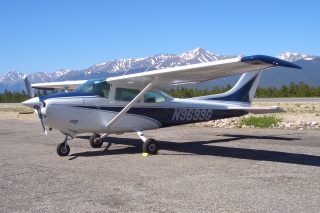
Looking around, I found one other blog talking about getting a C182 checkout. And if you get the Cessna Pilot's Association 182 Buyer's Guide, it also has a description of getting a good checkout. This is an excellent booklet, and I highly recommend it if you are thinking about buying a C182.
General
The Cessna 182 is a great plane that can haul 4 people and baggage well. Depending on the weight of the people and baggage, you might not be able to carry full fuel, but the fuel tanks are often large (80+ gallons). In order to carry the extra weight, the C182 is a heavier plane to begin with and has a larger engine, a constant speed prop, and cowl flaps.
The way the C182 was designed, it is very hard if not impossible to get the Weight and Balance out of the CG envelope. The downside to this is that the plane is nose heavy. You will notice during flaring.
The C182 is roomier inside than a C172 also. That will make your wife and family happy. You aren't squeezed in and touching shoulders like you do in a C172. The back seat is amazing roomy. I fit my friend comfortably in the back who is 6' 8".
The C182 has a higher avionics panel and dash; this is due to fitting more avionics and a larger engine up front. Make sure you crank the seat up high and use a cushion if you need to. Your sight picture during landing will likely be a little different due to this.
Constant Speed Propeller and Cowl Flaps
One of the big questions for some is how hard is it to deal with constant speed propeller and cowl flaps. These really are not that big a deal. I haven't seen it described well for some reason though. There are lots of possible power setting combinations, but you don't use them all.
For each phase of flight, MP and RPM belong in different positions. But once you know it, it is easy. You do not change them that often. The throttle is the main thing you move.
The RPM will just be set at your personal phase of flight setting. On my 1974 C182P, I use full high RPM of 2600RPM at takeoff, 2450 RPM most other times which is top of the green RPM arc, sometimes 2200 RPM for descending fast which is bottom of the green RPM arc.
When you adjust the throttle during normal flight, you will be looking at manifold pressure (MP) usually. For takeoff, full throttle. On my 1974 C182P, I usually cruise at 20" MP and 2450 RPM which is 67% power; you will need to pick your own cruise settings. I descend at 15" which is the bottom of the green MP arc. On downwind or approaching the pattern, I usually go to 15" in level flight as well to slow down.
When you descend on base/final for landing, and you pull power below the green MP arc, the constant speed prop can no longer keep the RPMs so the RPM will drop as the MP drops. At this point, you can look at either the MP or the RPM for your power setting. I tend to look for around 1800 RPM, but my wife tends to look for around 10" MP. They will occur around the same time. The other thing is to just listen to the engine and look outside and feel what it should be.
If you are flying IFR, you will want to determine your power settings for different phases there too. I use 17" approach, 12" ILS precision descent, 10" non-precision descent. I like to do this with 10 degrees flaps too.For cowl flap usage, just open them when you are climbing with high power, or close them during cruise and descents.
I do a LCGUMPS (Lights, Carb heat, Cowl flaps, Gas, Undercarriage, Mixture, Prop, Safety) check at different phases of flight (takeoff, climb, cruise, descent, landing), not just at landing . That way I check prop and cowl flaps and other times occasionally.
That is some of the main points, but there is more... When ever you change your RPM, do it slowly at the lower power setting when possible, and other items... Your instructor will give you all the extra details and specifics for your plane. Different C182 models and years will also have slightly different MP and RPM settings that are mentioned in the POH.
TakeoffsIt is good to practice all the different take off types with different flap settings. My personal preference for general takeoffs is 10 degrees of flaps.
When you takeoff, you will notice that more right rudder is required. That is of course due to the larger engine.
Speed and Slowing Down
When you change from a C172 to a C182, the C182 feels fast and does not seem to want to slow down. But it actually slows down pretty easily, you just have to take measures to do this. If you leave full power and level out, it will keep going fast. If you change to 15", 2200RPM, and level out, it will slow down quickly. You can fly it almost as slow as a C172 if you want.
It is important to slow the plane down before flaring. The easiest way to do this when you are new to a C182 is approaching the pattern before you even enter the downwind.
There are a few important things with landings. They are important for C172s too, but you can be sloppy with a C172, and it is not too bad.
- It is very important to slow the plane down to the speeds mentioned in the POH. Extra speed will cause the plane to float and make the flare harder to do correctly. It will require more back pressure on the yoke during flare too.
- It is important to trim the plane correctly. Since this is a heavier plane, it will be much easier to trim than to fight the yoke pressure.
- When you do flare, make sure you hold the nose high. Keep steadily pulling more and more back on the yoke. Remember a good landing is the stall horn bleeping right before the main wheels touch. Also do not relax on the back pressure until taxiing.
I think it is key to practice landings a bunch and consistently. They get easier and easier over time. My personal preference is for 20 degree flap landings, although I practice all types.
Stalls
Power off stalls are pretty much the same as C172.
The power on stalls are a little different due to the larger engine. Remember to use lots of right rudder. If you are not fully loaded and it is a cool day, it requires an extremely steep pitch up attitude to cause a stall with full power. For this reason, I wonder if it is good to practice with slightly less than full power. If you ended up in a true power on stall condition, it would probably be when loaded heavy or on a hot day which would probably closer attitude with lower power. Maybe practice both ways? Ask your instructor.
Stability
Since the C182 is a heavier plane to begin with, you will notice it is more stable and smooth on bumpy, turbulent days. It is nice and stable for IFR flying. If you trim it well, it will maintain altitude very nicely. I think crosswind landings are much easier in the C182 as well.
Carb Heat Usage
The carburated C182s tend to carb icing easier than other planes. Most C182s have a carburator temperature gauge that helps with this. When in cruise flight, I usually pull the carb heat partially so that the gauge indicates 10 degrees C. This keeps the carburator out of icing conditions, and it also helps to keep the intake temperatures best for fuel atomization. Full carb heat is not as good for atomization, and it lets in more unfiltered air. This partial carb heat usage should only be done in a plane with the gauge.
Summary
1st thing is to go find a good C182 instructor and get some instruction. Get a C182 POH for the plane you will rent or buy, and read it through thoroughly. Look through the POH and determine your own procedures or the differences from what you are used to.
I think most people become comfortable to practice on their own after only a few hours of instruction. The insurance may require a few more hours though.
These are some of my thoughts. Please, go ask your instructor for their thoughts. Then you need to form your own thoughts after you have flown the plane for a while.
/Brian